
The Society's History
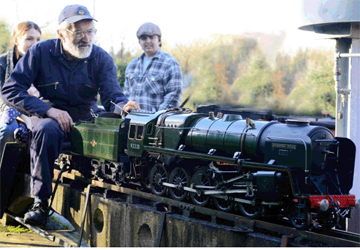
The original aim of the Society when it was founded back in 1976 was to provide a friendly club atmosphere for like minded people within the district of Basingstoke who like to maintain and preserve parts of Britain's industrial heritage by capturing it in miniature form. It was also the Society's intention to welcome and encourage an interest in engineering for the younger generations in machining, modelling and operating of miniature steam engines. These are all aims we still maintain today. Because of this, the Society has grown and prospered, boasting a range of over sixty members from all walks of life, still sharing the common interest of steam and model engineering.
From the very beginning, the Society was formed at our current location the Viables Craft Centre, where a plot of land behind the existing craft units was agreed for the footprint of a raised 3.5" and 5" gauge railway by the local council. Work quickly began on constructing the track where fundraising for its construction was helped by giving rides on the first piece of track to be laid, which now forms the 'back straight' of the current track. At that time there was only one completed steam locomotive in the club, a Maisie, which was used for the motive power. Today, we still use public rides as a source of income for the society, but we now have a much larger range of motive power - from steam to 'diesel' electrics - even diesel driven trains themselves.
It was decided the track would be built on solid concrete arches sitting on pad foundations, which made for a relatively slow construction process. Every Sunday, a team would cast one of the many concrete arches which make up the track circuit and every Tuesday a team would disassemble the mould once the concrete had cured. Railway track was laid on top of the completed arches simultaneously once a length of arch sections had been completed.
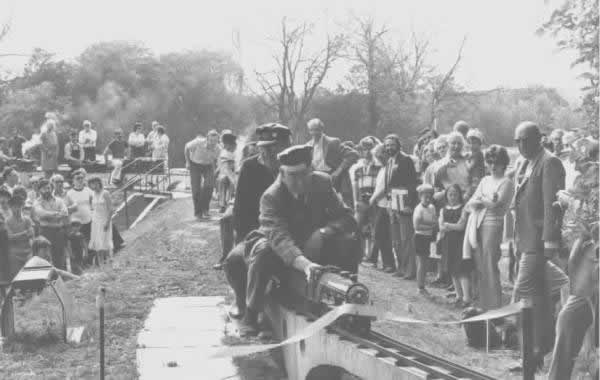
The entire circuit was completed by the end of 1979 and it was officially opened by Laurie Lawrence, then Editor of the Model Engineer Magazine on the18th May 1980. Below is the official club photo of the opening train appropriately hauled by Maisie, the first club loco.
The original track circuit consisted of an oval approximately 700 feet in length. A station canopy and tunnel were added later, with the portals of the tunnel being built by building apprentices from Basingstoke College. In the mid-eighties, the 'roundhouse' style steaming bays (where members build up the steam for their locomotives) was added with a central turntable and revised car unloading ramp was added.
Extending the track
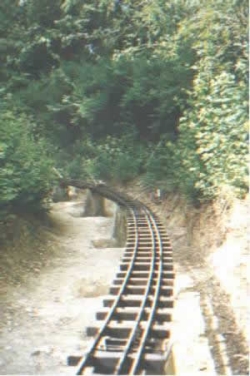
In 1999, work started on extending the original 700 foot circuit. The extension was completed in just six months during the winter of 1999-2000, requiring a 100 foot long cutting and laying of an addition 300 feet of railway track. The track came from the St. Albans society, who had moved from their site and had no suitable location for the track to be re-erected.
It is evident where the 'new' circuit leaves the old circuit as the railway track is no longer supported on the solid concrete arches but on pre-cast concrete blocks and steel angle beams.
Replacing the tunnel
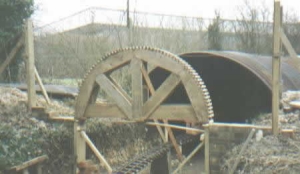
As a result of the extension, the original tunnel was disused as the track no longer ran through it. This was because the original 'outer curve' of the oval track circuit, where the tunnel was situated, effectively moved outwards. A year after the extension was finished, a new second tunnel was built during the winter of 2000/2001 using brick portals and old pig sty steel sheeting!
25th Anniversary of the track opening
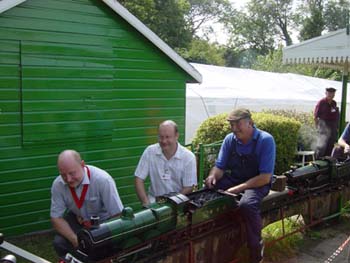
In 2005, the club held a special Gala weekend event to celebrate the 25th Anniversary of the opening of the track. The club organised an exhibition of members' work and models to recognise 25 years of progress.
The track was officially 're-opened' by the Mayor of Basingstoke. The photo shows the breaking of the ribbon in the same place the track was opened 25 years previously.
Change to public running
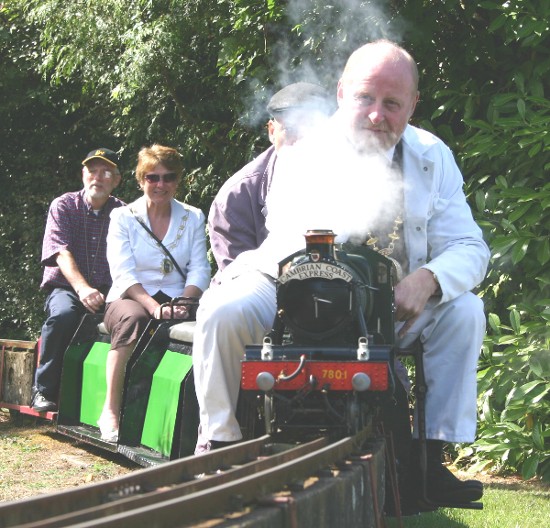
The Gala of 2005 also marked a change to public running; when the track circuit was originally opened at 700 feet in length, one trip included two laps of the track. When the track was increased to 1000 feet length, it was decided to reduce a trip length to just one lap. As part of the weekend running specials we decided to run two laps per trip as we had done in the 1980&s. This worked so well it has stuck ever since!
2006 marked the 30th anniversary of the Society's formation and a similar event was held.
New Platform and Canopy
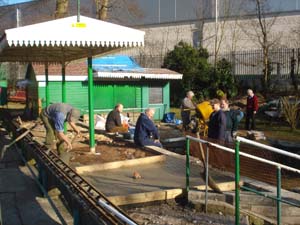
In early 2009 work began on replacing the station platform to making it wider to accommodate more passengers and to create an open plan view of the activities of the locomotives on the steam bays.
In 2010, in just three months, the old station canopy was taken down and replaced with new. The new canopy was both larger to cover the wider platform area and of a stronger construction to last us for another at least another twenty years!
Model Engineering
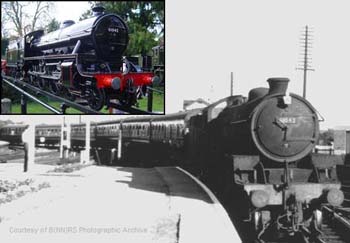
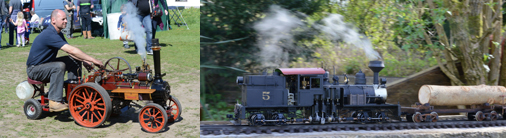
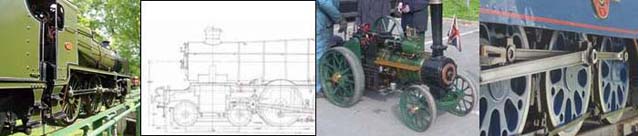
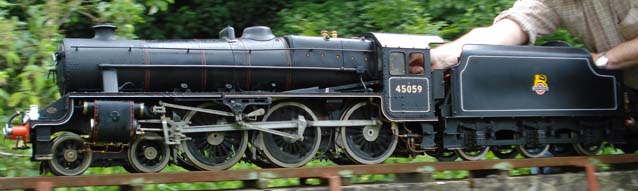
The steam and electric powered locomotives and traction engines you see running at our railway today have mostly been built by amateur engineers in their own workshops with the use of heavy machinery; lathes, milling machines and pillar drills, for example. The engines are built from engineering drawings (like the full size were) which were largely published in fortnightly magazines, such as 'The Model Engineer' or 'Engineering in Miniature'. They are designed as models either from fictitious engines, or based on the full sized prototypes. In recent years a few ready made and kit models have become available, broadening the options for the aspiring owner.
The model steam engines burn coal to produce steam under pressure, working around 100psi and so they need to have boiler inspections and tests every year. They work in exactly the same way as the full size engines do, using only mechanical means with no electronics anywhere!
Once the models are mechanically completed, our society members finish (paint) the locos to replicate the prototypes, with the help of water transfers bought from suppliers so they look, and perform in exactly the same way their bigger sisters do.
The society also has a large number of members with an interest in stationary engines, such as Stuart engines which are stationary cylinders which produce motion. They were originally used in mining for water pumping and later for powering the industrial factories - replicating the beginning of the industrial revolution. There are also a significant number of members who own traction engines or road locomotives, but unlike the locomotive members are not restricted to the on-site club track!
The Basingstoke and District model engineers welcome people from any background: you don't need any knowledge or pre-requisites to join - only enthusiasm for what we do. If you are interested in joining then do not hesitate to contact us by email or come and have a chat at a running day. See the Membership page for details.